Primate Gripper

Wearable data collection for task automation

The robot learns from what you do
Wear Work Train Deploy
Product

The worker wears it. The robot runs it.

While you wear the gripper on shift, it records what the cameras see, where your hand moves, and when the fingers open and close. Then the same gripper attaches to the arm and the robot performs the job.

Human hand holding the gripper on the left, identical gripper mounted on a robot arm on the right
Handheld gripper
Wear it to teach the robot.
Press one button on the gripper to record:
  • Its position and orientation
  • What the two cameras see
  • When the fingers open and close
Robot gripper
Attach it to the robot to do the job.
  • Same device the worker wore
  • Performs the task it learned
  • Works with any robot
How it works

From human skill to robot skill.

The gripper records the workers' normal tasks, and the robot learns from that data.

Record
The worker wears the gripper and does their normal job. One click on the platform starts recording, and every frame captures what the cameras see, the position and orientation of the gripper, and how open the fingers are. See what is recorded ↓
Review
The worker watches the recordings on the platform and scores them like a performance review. They mark errors, name each step, and rate how well the task was done. No AI expertise is needed. They only need the judgment they use at work. See the review screen ↓
Train
The worker clicks on the platform and trains the robot on our cloud infrastructure, so the customer needs no expensive hardware for it. Roughly 500 recordings are enough for one task. See the proof ↓
Deploy
The worker clicks start on the platform and the robot does the task it learned, on an off-the-shelf arm (ABB, KUKA, UR, etc.) at the customer site. We bring the PC for the AI, and the arm too if the customer does not own one.
Improve
The robot does the task, and when it occasionally makes a mistake the worker marks what went wrong on the platform and clicks to train it again. The robot becomes more reliable and faster with every round.
Recording in action
Left gripper cameraiWhat the left gripper's camera sees.
Right gripper cameraiWhat the right gripper's camera sees.
Worker viewiThe worker doing the task, from the outside.
3D positioniPosition and orientation of each gripper in 3D, live.
Left gripper camerai
What the left gripper's camera sees.
Right gripper camerai
What the right gripper's camera sees.
Worker viewi
The worker doing the task, from the outside.
3D positioni
Position and orientation of each gripper in 3D, live.
Review screen
Quality ratingiRate each recording, like grading a person's work.
LabelsiLabel each action so the robot learns the sequence.
Step bariMark the start and end of each step so the robot learns the sequence.
Error bariMark where the task went wrong.
Quality ratingi
Rate each recording, like grading a person's work.
Labelsi
Label each action so the robot learns the sequence.
Step bari
Mark the start and end of each step so the robot learns the sequence.
Error bari
Mark where the task went wrong.
One place to record, review, train, run, and improve.
One device, two uses

Collect data. Or drive the robot directly.

The gripper tracks its position and 3D orientation with enough precision to drive the robot in real time. Wear it to collect training data in production, or hold it to drive the robot by hand.

Why Primate

Four ways to teach a robot. Three fail in real work.

Some methods train the robot in a clean copy of the world, not on the factory floor. Others train it on a human hand, not its own gripper. Either way, it learns the job in a place and a body that are not its own.

MethodHow it worksReality check
Simulation The robot is trained in a physics simulator that approximates objects, materials, contacts, and dynamics. Deformable materials like cloth, foam, food, liquids, and phenomena such as fracture, are expensive or impossible to simulate accurately. For every element in the simulation, the user must set exact parameters such as friction, stiffness, and mass. Those parameters most likely differ from reality.
Teleoperation A person controls the robot arm with a joystick and performs a task with it. Because the operator uses a joystick instead of their own arm, the motion is unnatural and the operator lacks full control, so they move slowly and carefully to prevent damage, and the robot inherits this caution. Because the operator must control the robot directly, one robot needs one operator for as long as data is collected.
Learning from video The robot is trained on video of human hands from public footage or a body-mounted camera. The human hand is far more complex than any robot hand, so there is an embodiment gap even with five-fingered robot hands. Objects also occlude the fingers during manipulation, so inferring the fingers' poses is challenging. Moreover, videos will never provide force or tactile data, and this is a modality problem. See it happen ↓
Primate Gripper A worker wears the robot's own gripper and sensors while doing the actual job. There is no embodiment gap, because the training data comes from the same hand and sensors the robot will use. The work is the customer's real task during real production, not a mockup, not a proxy, and not a simulation.
What it does

Serious work, simple gripper.

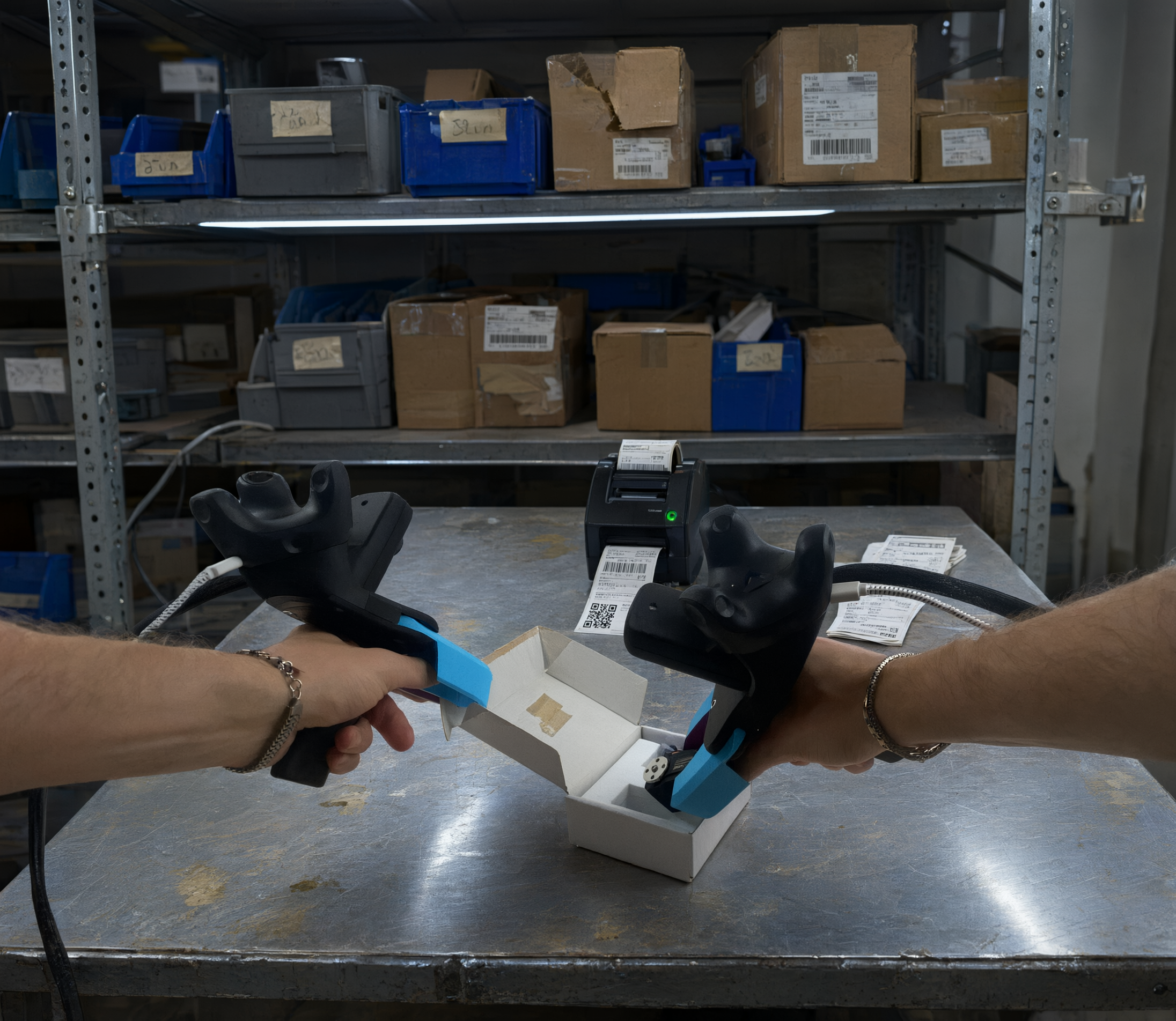
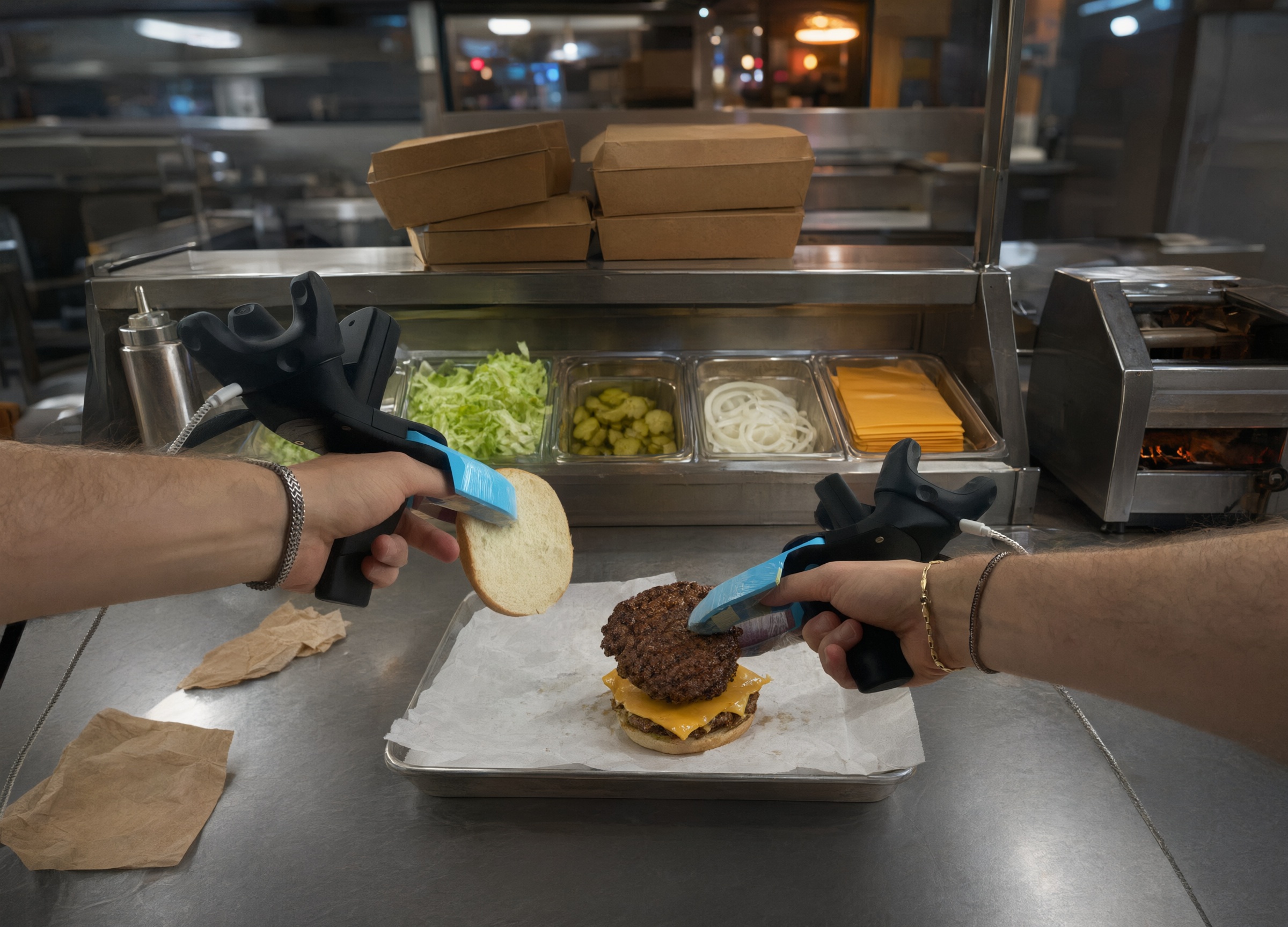
A two-finger gripper can already handle many high-value tasks, for example warehouse pick-and-pack and food assembly.

Worker wearing two-finger grippers picks and packs a box in a warehouse
Pick & pack
Worker wearing two-finger grippers assembles a burger in a kitchen
Food assembly
Roadmap

Beyond the gripper.

The gripper already handles tasks like pick-and-place and assembly. The glove is the next step: it gives the robot dexterity closer to a human hand and unlocks new tasks without adding delays. The worker wears one glove and the robot wears its twin. Both use the same kinematics, sensors, and cameras, so skills transfer directly from the human hand to the robot hand.

Once the hands are dexterous enough, the robot also needs to move around the plant. A few unobtrusive sensors attach to the worker's normal clothes, forming a sensor suit that needs no special gear. The suit records whole-body movement during normal tasks. It captures how the worker coordinates moving and manipulating objects, without slowing the work or changing the routine. That data is what humanoid robots need to walk, balance, handle objects, and operate in human spaces.

Team

Built by roboticists.

Luigi Campanaro
Co-founder & CEO
  • PhD, Robotics & AI · University of Oxford.
  • Postdoctoral Researcher · EPFL.
  • Designed one of the first three reinforcement-learning locomotion controllers for legged robots in the UK.
  • Built the AI that automated phone loading into chargers for a high-volume production line, completing 550 consecutive cycles without error. Watch the video ↓
Locomotion controller · RL demo ↗
Axel Praplan
Co-founder & CTO
  • MSc in Robotics · EPFL.
  • Robotics Research Engineer · EPFL.
  • Built a full tendon-driven humanoid robot from scratch: mechanical design, actuation, control, integration.
  • Deep expertise: hardware design, mechatronics, rapid prototyping.
Tendon-driven humanoid · built from scratch ↗
Advisors
Prof. Daniele De Martini
Professor of Robotics
University of Oxford
Co-leads the Mobile Robotics Group at Oxford alongside Prof. Paul Newman (Founder and CEO of Oxa). His research on robotic perception and autonomy enables robots to navigate and interpret the world in the most challenging conditions.
Prof. Perla Maiolino
Professor of Robotics
University of Oxford
Deputy Director of the Oxford Robotics Institute. She developed CySkin, one of the few existing large-area robotic skins, giving robots the sense of touch that makes safe, intelligent manipulation possible.
Alf Müller
Alf Müller
Entrepreneur in Digital Commerce
Bastelgarage.ch
Co-owner, Purecrea GmbH / Bastelgarage.ch
Swiss entrepreneur and maker, co-owner of Purecrea GmbH behind Bastelgarage.ch, one of Switzerland's largest online stores for DIY electronics, robotics and maker products. He combines e-commerce with hands-on engineering, rapid prototyping and robotics, electronics and AI.
Get started

Turn your work into robot skills.

Reserve your units now or schedule a call to explore how our gripper could automate your tasks.